
Key takeaways
- 1An AI agent reads a message, document or camera feed, decides what to do and acts in your systems; a chatbot only answers.
- 2The useful agents are narrow: one task, a few tools and clear rules, such as taking WhatsApp orders or reading invoice emails.
- 3Anything with a right answer, like prices, totals and policies, should be checked in code, not left to the AI model.
- 4Model prices keep falling, so choose the model per task on cost and accuracy and test before switching.
- 5Choose a company that shows real agents in production, explains its guardrails and hands you the logs, code and accounts.
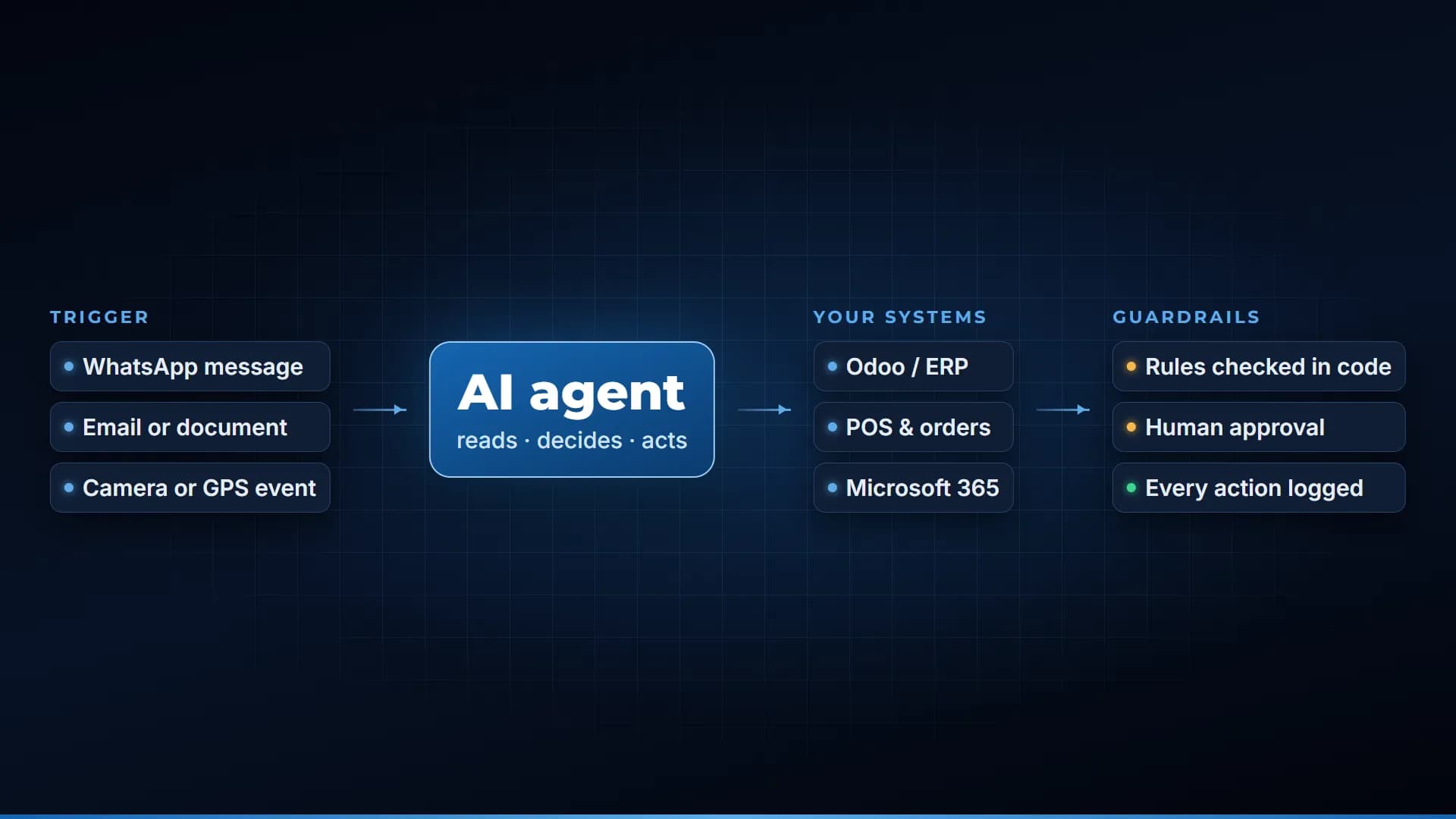
Custom AI agent development means building an AI agent for one specific job in your business. Unlike a chatbot, an agent acts: it reads a WhatsApp message, an email, a document or a camera feed, decides what to do, and updates your ERP, POS or Microsoft 365. The agents that work in practice are narrow, connected to the right tools, and wrapped in rules checked in code, human approvals and logs.
AI agent or chatbot?
A chatbot answers questions from what it knows. An AI agent uses tools: it can look up stock, create an order, update a record, send a report or raise an alert. That is what makes it useful, and also why it needs limits. A good agent has a short list of things it may do, and everything else is refused.
Five agents we have built
- WhatsApp ordering agent: takes orders by message or voice note from each branch's menu, checks every price in code, confirms with buttons and sends the order to the POS. See our WhatsApp ordering system.
- Kitchen camera agent: watches kitchen cameras and flags phone use over 10 seconds, and smoke or vaping when a person is present, with a timestamped photo. See AI computer vision.
- Form-reading agent: reads handwritten guest feedback forms and turns them into a live dashboard by branch.
- Mailbox agent: reads a Microsoft 365 sales mailbox and builds a pipeline report of every lead conversation.
- Dispatch assistant: ranks free trucks by distance to a pickup and flags late trips, with the dispatcher confirming each assignment. See our dispatch software.
Guardrails that make agents safe
- Rules in code: prices, totals, stock and policies are checked by ordinary code. The AI never decides a price.
- Human approval: anything that goes to a customer or moves money waits for a person.
- Least permission: the agent's account can do only what its job needs.
- Logs: every input, decision and action is recorded, so you can see what happened and why.
- Watchdogs: an alert when an agent fails or stalls, so it never breaks quietly.
Our guide to AI agent security basics covers sign-in and permissions in more detail.
Choosing the model
Model prices keep falling. OpenAI's GPT-6.1 Terra, for example, costs half as much as the model above it and is built for agents that use a computer. That does not mean every agent should switch. The right model is the cheapest one that gets your task right, so measure cost and accuracy per task on your own messages and documents, and test before changing.
What it costs
Most AI agent development companies quote a build fee, plus running costs and optional support. What moves the price:
- how many tasks and tools the agent handles,
- which model it uses and how many messages or documents it processes,
- how many systems it connects to, and whether they have an API,
- the approvals, logging and monitoring you need,
- support, tuning and model updates after launch.
How to choose an AI agent development company
1. Ask to see agents running in production, not demos. 2. Ask what the agent is not allowed to do, and how that is enforced. 3. Ask which checks run in code and which steps need a person. 4. Ask who owns the code, the accounts and the logs. 5. Ask how they choose and change models, and how they test a change. 6. Ask how failures are reported and how fast they are fixed.
We are an AI agent development company building agents for businesses in the UK, the UAE, Saudi Arabia and Pakistan. Tell us the task you want an agent to take over and we will show you how it would work, and what it would check.
Frequently asked questions
Building an AI agent for a specific job in your business: it reads messages, documents or camera feeds, decides what to do, and acts in your own systems, such as your ERP, POS or Microsoft 365, within rules and approvals you set.
A chatbot answers questions. An AI agent uses tools: it can check stock, place an order, update a record or send a report, within the permissions you give it.
It depends on how many tasks and tools the agent handles, which model it uses and how much it processes, how many systems it connects to, and the approvals, logging and support you need. Most companies quote a build fee plus running and support costs.
They can be, with the right guardrails: limited permissions, checks in code for prices and totals, human approval for anything that goes to customers or moves money, and a log of every action.
Yes. We build and support AI agents remotely for businesses in the UK, the UAE, Saudi Arabia and Pakistan.
Get new articles by email
How we build automation and software, with the lessons learned. One short email when a new article goes up. No spam.
- #AI Agents
- #AI Agent Development
- #Custom AI
- #Automation