

Key takeaways
- 1An n8n agency designs, builds, hosts and maintains n8n workflows for you, from simple app-to-app tasks to AI agents connected to your systems.
- 2Self-hosted n8n has no execution limits but needs a server, backups and upgrades; n8n Cloud is paid per plan and n8n runs it for you.
- 3n8n is the right tool for most integrations between popular apps; custom code is better for heavy data work, systems without an API and strict audit rules.
- 4Upgrades matter: n8n 3.0 removes old nodes and drops npm installs, so someone has to own testing and migration.
- 5Ask any agency for real workflows, who owns the instance and credentials, how failures are reported and how upgrades are handled.
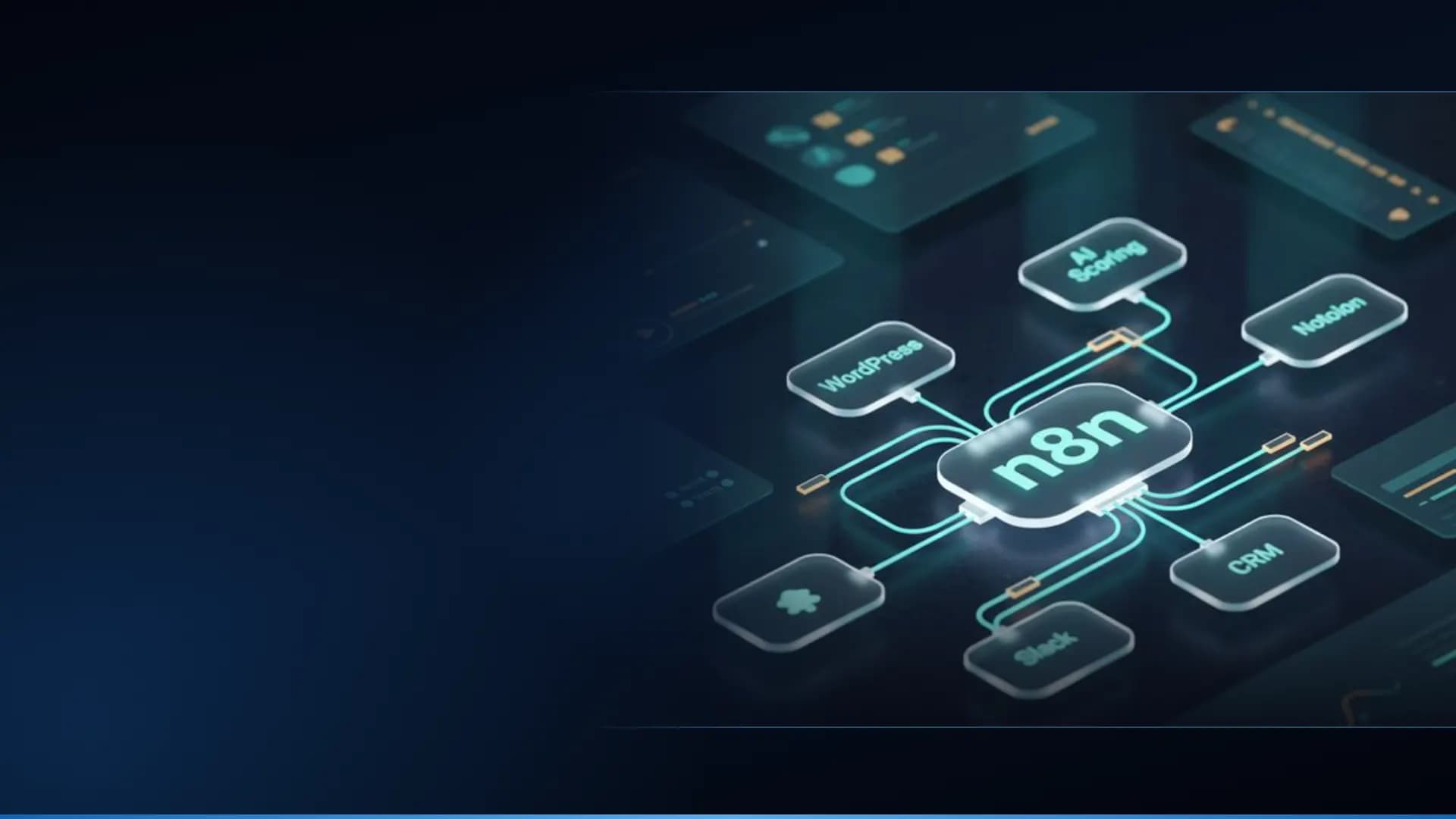
An n8n agency designs, builds, hosts and maintains n8n workflows for your business, so the repetitive work between your apps runs on its own. A good one also knows when n8n is the wrong tool and writes custom code instead, and it owns the boring parts that keep automations alive: credentials, error alerts, backups and upgrades such as the move to n8n 3.0.
What an n8n automation agency builds
- App-to-app workflows: a form entry becomes a CRM record, a Slack message and a row in a sheet.
- Back-office automations: invoices, purchase orders and reports moved between your ERP, email and accounts.
- AI steps and agents: emails sorted and answered, documents read, leads scored, with a person approving anything that goes to a customer.
- Scheduled jobs: daily reports, reminders and data syncs on a timer.
- Monitoring: an error workflow that alerts someone when a run fails, so nothing breaks quietly.
Self-hosted n8n or n8n Cloud?
Self-hosted n8n Community Edition has no execution limits and keeps your data on your own server, and it can reach systems on your private network. You pay for the server and for someone to run backups, security and upgrades. From n8n 3.0, self-hosted n8n runs on Docker; installing with npm is no longer supported.
n8n Cloud is a paid plan where n8n runs the server for you, priced by the number of workflow executions. It suits teams that want automations without looking after infrastructure.
An agency should help you choose, then set up whichever you pick properly: separate credentials, backups, and a test copy for upgrades.
Where n8n stops and custom code starts
n8n is the right tool for most integrations between apps that have an API. We write custom code, in Python or Node.js, when:
- the system has no API, such as an older desktop ERP or a portal you can only log in to,
- the job moves large volumes of data or needs heavy calculation,
- the rules are complex and must be tested, like payroll or accounting checks,
- every action needs a strict audit trail.
Often the answer is both: n8n runs the flow and calls a small custom service for the hard step. Our business process automation work mixes the two, and our 6 real automation examples show where each fits.
Why upgrades need an owner
n8n 3.0, due as a stable release in early December 2026, removes old nodes such as Function, Item Lists, Cron and Interval, makes security defaults stricter, and cannot be rolled back except from a backup. Workflows built years ago by someone who has since left are exactly the ones that break. An agency that maintains your instance runs the Migration Report, fixes flagged workflows and tests on a copy first. Our n8n 3.0 news story lists what changes.
What it costs
Agencies usually quote a fixed build fee per workflow or project, plus an optional monthly fee for hosting, monitoring and changes. What moves the price:
- how many workflows and how many systems they connect,
- whether AI steps, custom code or a system without an API are involved,
- self-hosted or n8n Cloud, and who runs the server,
- how quickly failures must be fixed.
The n8n licence or plan is a separate cost: our Zapier vs Make vs n8n comparison covers 2026 pricing for each tool.
Six questions to ask an n8n agency
1. Can you show real workflows you built, with a before and after? 2. Who owns the n8n instance and the credentials when we stop working together? 3. How are failures reported, and how fast are they fixed? 4. How do you handle upgrades such as n8n 3.0? 5. When would you use custom code instead of n8n? 6. Will we get documentation for every workflow?
We work as an n8n automation agency for businesses in the UK, the UAE, Saudi Arabia and Pakistan, building on n8n, Make, Zapier or custom code, whichever fits. Tell us which task eats the most hours and we will suggest the right tool and the workflow for it.
Frequently asked questions
It finds the repetitive work in your business, designs n8n workflows to do it, connects them to your apps and data, hosts or sets up the n8n instance, and keeps the workflows running through failures, changes and n8n upgrades.
Self-host if you want no execution limits, your data on your own server, or private network access, and you have someone to run backups and upgrades. Use n8n Cloud if you would rather pay a plan and let n8n run the server.
It depends on how many workflows you need, how many systems they connect, whether AI steps or custom code are involved, and whether the agency hosts and maintains the instance. Most agencies quote a build fee plus an optional monthly support fee.
Not always. n8n counts a whole workflow run as one execution and can be self-hosted, which suits busy, multi-step workflows. Zapier is the quickest for simple tasks, and Make is often cheaper for medium workflows. Our Zapier vs Make vs n8n guide compares them.
Yes. We build and maintain automations remotely for businesses in the UK, the UAE, Saudi Arabia and Pakistan.
Get new articles by email
How we build automation and software, with the lessons learned. One short email when a new article goes up. No spam.
- #n8n
- #n8n Agency
- #Workflow Automation
- #Zapier
- #Make.com