
Key takeaways
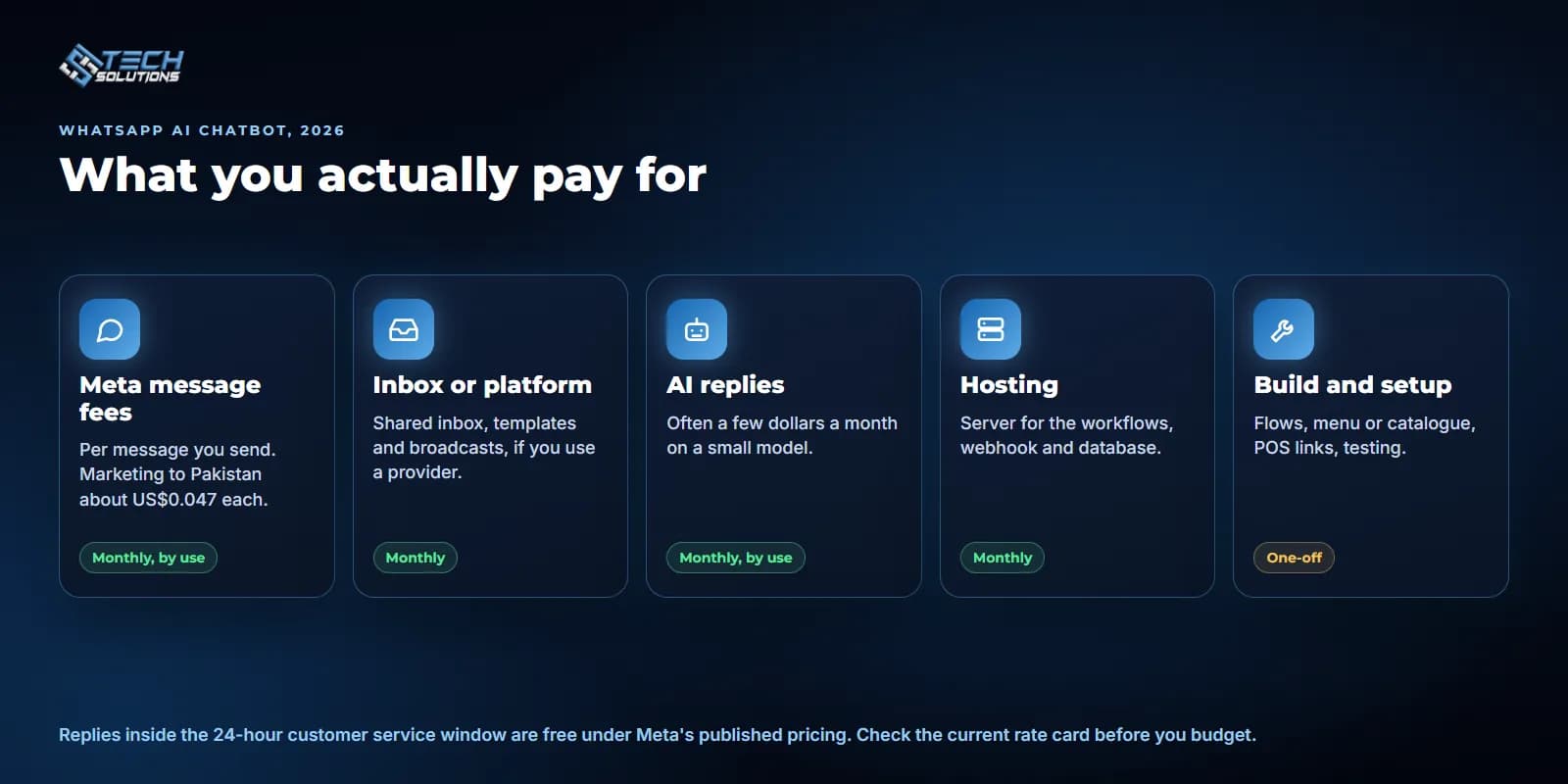
- 1A WhatsApp AI chatbot has five costs: Meta message fees, an inbox or platform, AI replies, hosting, and the one-off build.
- 2Meta charges per message delivered. Marketing messages to Pakistani numbers cost about US$0.047 each.
- 3Since 1 October 2026, replies inside the 24-hour customer service window are charged too, after 1,000 free service messages per number each month. Reports put the Pakistan service rate at about US$0.015.
- 4AI replies on a small model usually cost a few dollars a month. Integrations, not the AI, drive the build price.
- 5Use Click to WhatsApp ads (chats from them stay free for up to 7 days), keep bot replies short and useful, and send fewer, better marketing messages.
A WhatsApp AI chatbot for a business in Pakistan has five costs: Meta's per-message fees, an inbox or platform, the AI itself, hosting, and a one-off build. The AI is usually the cheapest part. What decides your monthly bill is how many template messages you send, especially marketing broadcasts, and what decides your build price is how many of your own systems the bot has to talk to.
People keep asking this question, and the honest answer is "it depends" until you split it into parts. Here is each part, with the numbers we can check and the ones you should confirm before you budget.
1. Meta's message fees
Since July 2025, Meta has charged per message instead of per conversation. According to its pricing documentation:
- You pay for each message Meta delivers. Templates come in three types: marketing (offers, broadcasts), utility (order updates, reminders) and authentication (one-time codes). Messages customers send you are free.
- Replies are no longer free. From 1 October 2026, Meta charges for service messages, the normal replies you send inside the 24-hour customer service window, and for utility templates sent inside it. Each business number gets 1,000 free service messages a month; charging starts at the 1,001st.
- Click to WhatsApp ads still open a free window. If a customer starts the chat from one of your ads, Meta's documentation says the free window can stay open for up to 7 days, and messages in it are free.
- Rates depend on the customer's country. For Pakistani numbers, a marketing message costs about US$0.047, and reports of the October 2026 rate card put the service and utility rate at about US$0.015 per message.
Two warnings. First, Meta can change rates on the first day of any quarter, so check your provider's invoice or Meta's current rate card before you plan around any number here. Second, if you use a provider (a "BSP"), they may add their own markup on top of Meta's fee. Our news story on WhatsApp's new charges for replies explains the October change in more detail.
2. An inbox or platform
Someone has to read the chats the bot cannot handle. You can build a simple staff view yourself, or pay a provider for a shared inbox with templates, broadcasts and reports. Providers charge a monthly subscription, usually by number of users or contacts. If you build directly on Meta's Cloud API, there is no platform fee from Meta itself.
3. The AI replies
This is the part people worry about most, and it is usually the smallest line. On a small, fast AI model, a few thousand replies a month typically cost a few dollars. Larger models cost more per reply, but most customer questions such as menu, prices, hours and order status do not need them.
What matters more than the model is what the AI is allowed to say. In the WhatsApp ordering bot we built for a five-branch restaurant chain, the AI only reads the branch's own menu, and a separate step checks every price in code before the customer confirms. A cheap model with good rules beats an expensive model with none.
4. Hosting
A custom bot needs somewhere to run: the workflows, the webhook that receives messages from Meta, and a small database. For most small businesses, that is a modest monthly server bill. Our restaurant bot runs as 13 small n8n workflows on the WhatsApp Business API, each with one job, plus watchdogs that check for stalled chats every 2 minutes.
5. The build
This is the one-off cost, and it varies the most. What pushes it up:
- Your systems. Sending orders into a POS, checking stock, assigning riders or writing to accounts each needs its own integration.
- Branches and menus. Different menus, prices or delivery areas per branch.
- Voice notes and languages. Many Pakistani customers send voice notes or mix Urdu and English. Handling both properly takes extra work and testing.
- Handover to staff. A clean way for a person to take over a chat, and for the bot to stay quiet while they do.
- Payments and campaigns. Payment links, order tracking codes and marketing broadcasts.
If your chats are mostly questions and bookings, you may not need a custom build at all. Meta's own WhatsApp Business AI agent is free to start. We compared the two in Meta's WhatsApp AI agent vs a custom bot.
A worked example
Take a restaurant that gets 3,000 customer chats a month and sends one marketing broadcast to 1,000 customers.
- The 3,000 chats: customers message first, so the bot's replies are service messages. If the bot sends about 3 replies per chat, that is 9,000 replies; the first 1,000 a month are free and the other 8,000 at about US$0.015 cost about US$120.
- The broadcast: 1,000 marketing messages at about US$0.047 each is about US$47.
- AI replies: a few dollars on a small model.
- Hosting and inbox: whatever your server and any provider charge each month.
The lesson: since October 2026, the number of replies your bot sends matters as much as broadcasts. A bot that answers in one complete message instead of three short ones costs a third as much in Meta fees.
How to keep the bill low
- Answer in fewer, fuller messages. Every bot reply is now a billed service message after the first 1,000 a month, so one clear reply beats three short ones.
- Use Click to WhatsApp ads when you advertise, so chats started from them stay free for up to 7 days.
- Let customers start the chat. Put your WhatsApp link on menus, receipts, Google Business Profile and your website.
- Send fewer, better broadcasts to customers who have opted in and ordered before.
- Use a small AI model for routine answers and keep prices and stock checks in code.
- Do not use unofficial WhatsApp tools. Bots that drive the normal app or WhatsApp Web break WhatsApp's terms and can get the number banned. The real cost of that is losing your customers' chat history and your number.
What to ask before you sign
- Which of Meta's fees are included, and is there a markup per message?
- What is the monthly platform or inbox fee, and what does it include?
- Which AI model is used, and who pays for it?
- What does the bot connect to on day one: POS, stock, delivery, payments?
- How does a person take over a chat?
- Who maintains the bot when your menu, prices or Meta's rules change?
If you want a price for your own case, see our WhatsApp ordering system and chat automation services, read how we built the restaurant ordering bot, or tell us how your customers order today.
Frequently asked questions
There is no fee to use the platform itself, but Meta charges for each message it delivers: marketing, utility and authentication templates, and since 1 October 2026 service replies too. Each number gets 1,000 free service messages a month.
About US$0.047 per delivered marketing message to a Pakistani number on the 2026 rate card. Meta can change rates on the first day of each quarter, so check the current rate card or your provider's invoice.
When a customer messages you, a 24-hour window opens and you can reply with normal messages. Since 1 October 2026 those replies are charged after the first 1,000 a month per number. After the window closes you can only send approved templates.
Usually very little. On a small AI model, a few thousand replies a month typically cost a few dollars. The bigger costs are message fees, the build and keeping the bot connected to your systems.
Not for a proper bot. Tools that drive the normal app or WhatsApp Web break WhatsApp's terms and can get your number banned. A business chatbot should run on the WhatsApp Business Platform (the API).
Get new articles by email
How we build automation and software, with the lessons learned. One short email when a new article goes up. No spam.
- #WhatsApp Business API
- #WhatsApp Chatbot
- #Pricing
- #Chat Automation
- #Pakistan