

Key takeaways
- 1Fingerprint attendance machines are the cheapest option, with basic ZKTeco models listed from about Rs 10,000 to Rs 17,000 at Pakistani resellers in October 2026.
- 2Face recognition terminals start at about Rs 30,000 and need no touch, so they work where worn, dirty or wet fingers fail a fingerprint scan.
- 3Offices, schools and clinics do well with fingerprint; factories, construction sites, warehouses and kitchens are better served by face or palm recognition with a backup method.
- 4Pakistan now recognises face and iris scans as legal biometric identifiers alongside fingerprints, for official identity checks.
- 5The device only records clock-ins. The time savings come from connecting it to rosters, duty-hour rules and payroll.
A biometric attendance system in Pakistan uses fingerprint or face recognition, and many devices now do both. Fingerprint machines are cheaper, with basic models listed from about Rs 10,000 at Pakistani resellers in October 2026, and they suit office staff. Face recognition terminals start at about Rs 30,000 and suit factories, construction sites, warehouses and kitchens, where worn or dirty fingers fail a scan and nobody wants to touch a shared sensor. Whichever you choose, the device only records clock-ins: the time savings come from connecting it to rosters and payroll.
How fingerprint and face attendance work
Both stop "buddy punching", where one person signs in for another, which paper registers, cards and PINs cannot.
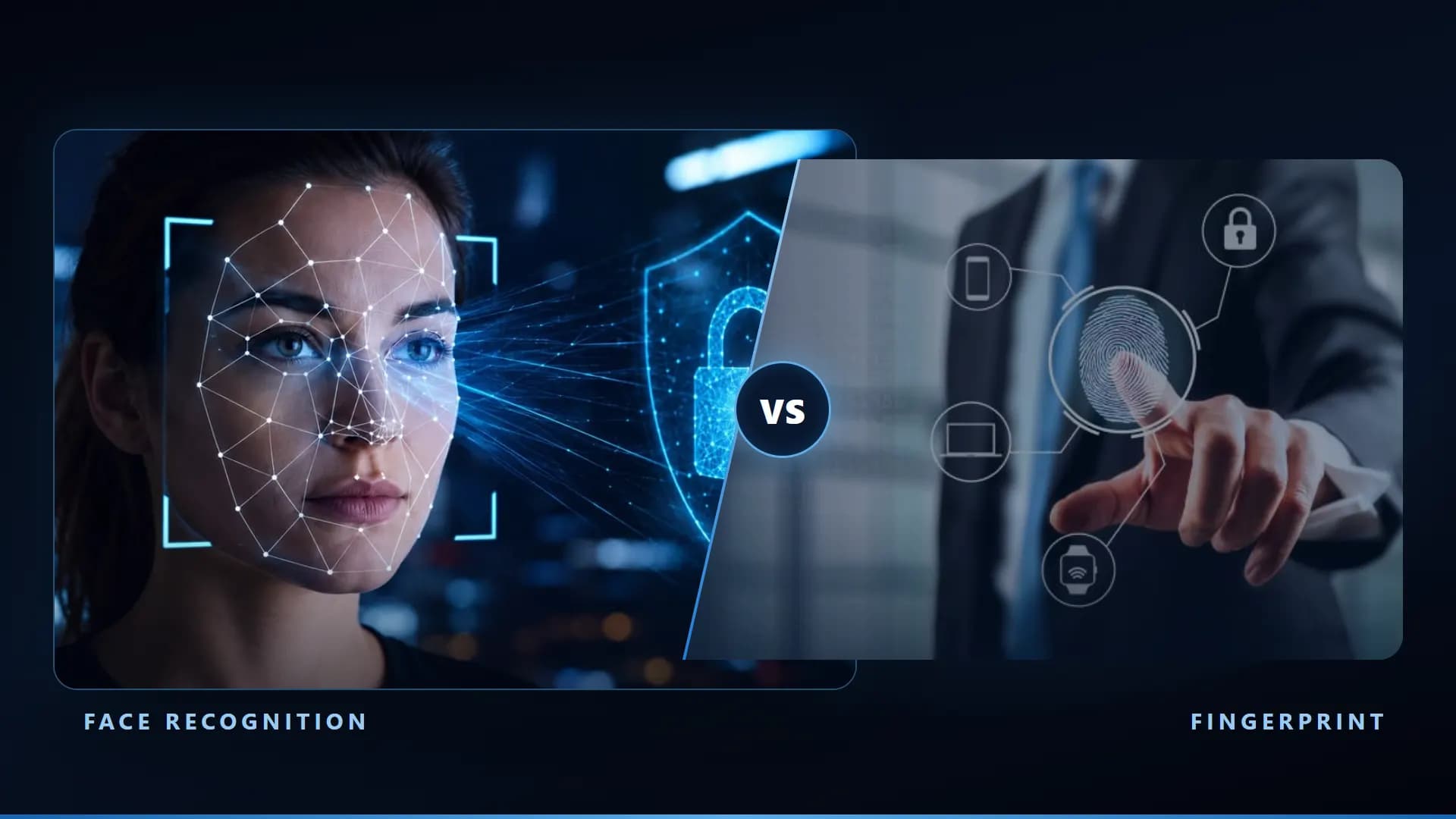
- Fingerprint: the employee presses a finger on the sensor, and the device compares it with the fingerprints enrolled for each person. ZKTeco lists fingerprint matching in under 0.3 seconds on its SpeedFace-V5L terminal.
- Face recognition: a camera captures the employee's face as they stand in front of the terminal and compares it with the enrolled faces. The same terminal lists face matching in under one second, with no touch.
- Palm: some terminals also read the palm without contact. It is less common, but useful where faces are covered by helmets or masks.
Fingerprint vs face: the differences that matter
- Price: fingerprint machines cost less. Face terminals typically cost two to three times as much for the device.
- Worn or dirty fingers: fingerprint readers struggle with worn, cut, dry, wet or dirty skin. This is the main reason factories, construction companies and restaurant kitchens move to face recognition.
- Hygiene: a fingerprint sensor is touched by every employee, several times a day. Face recognition is touchless.
- Placement: face terminals need even light. Mount them indoors at the entrance, away from direct sunlight and strong glare behind the person.
- Covered faces: staff wearing helmets or face coverings may need to remove them at the terminal, or use fingerprint, palm or a card as their method.
- Capacity: check how many people the device holds. ZKTeco's SpeedFace-V5L, for example, holds 6,000 faces and 6,000 fingerprints as standard.
Biometric attendance machine prices in Pakistan (October 2026)
These are listed prices at Pakistani resellers we checked on 24 October 2026:
- Basic fingerprint (ZKTeco K14): about Rs 10,000
- Networked fingerprint (ZKTeco K40 or K50): about Rs 15,000 to Rs 17,000
- Entry face recognition with Wi-Fi (ZKTeco VF680): about Rs 30,000
- Palm recognition (ZKTeco P260): about Rs 38,000
- Face and fingerprint terminals (ZKTeco uFace800, G3): about Rs 59,000 to Rs 81,000
Prices move with the exchange rate and stock, so get a current quote. Installation, cabling, software and a payroll connection are extra.
Which one should you choose?
- Offices, schools and clinics: a networked fingerprint machine is usually enough. Choose face recognition if hygiene matters more than budget.
- Factories, construction sites, warehouses and kitchens: face or palm recognition, with fingerprint or a card as a backup for anyone the device struggles to read.
- Several branches: buy networked devices (LAN or Wi-Fi) so all branches feed one system, instead of copying logs from each machine by USB.
- Guards and field staff: a wall-mounted device cannot see them. A mobile app with PIN sign-in and GPS check-in records attendance on site. We built this for a UK security company, described in our workforce ERP case study.
Face scans are now legal ID in Pakistan
Pakistan has amended its rules to recognise facial photographs and iris scans as legal biometric identifiers alongside fingerprints, and they are already used for services such as online passport applications. This concerns official identity checks, not workplace attendance, but it shows face recognition is now a standard way to prove who someone is. For your own system, tell staff what is recorded and who can see it, and delete a person's data when they leave.
The device is the easy part: connect it to payroll
Most attendance problems start after the device is installed. HR exports the log to Excel, checks every row against the roster and the overtime policy, and argues with staff about missed punches. That work is the same whichever biometric you choose.
A better setup pulls the logs automatically, compares clock-ins with planned shifts, applies your duty-hour and overtime rules, and gives payroll a verified report. Our biometric attendance system service does exactly this: we supply and install ZKTeco devices, then connect them to your rosters and payroll. If you also need HR, payroll and accounts in one place, see how an ERP system works and our custom ERP software.
Buying checklist
1. Headcount: the device holds more people than you employ, with room to grow. 2. Network: LAN or Wi-Fi, so logs reach your software without USB copying. 3. Backup method: card, PIN or a second biometric for people the device cannot read. 4. Data export: a documented way to pull logs into payroll software, not only a report on the screen. 5. Power: a UPS for the device, so clock-ins continue during load-shedding. 6. Local warranty and support: someone who can replace a faulty unit quickly.
Need devices installed and connected to payroll in one go? Tell us how many staff and sites you have, and we will suggest the right devices and setup. We also install CCTV on the same network.
Frequently asked questions
Fingerprint is cheaper and works well for office staff with clean, dry hands. Face recognition costs more but needs no touch and is not affected by worn or dirty fingers, so it is the better choice for factories, construction sites, warehouses and kitchens. Many businesses buy a terminal that supports both and use one as a backup.
Listed prices at Pakistani resellers in October 2026 run from about Rs 10,000 for a basic ZKTeco fingerprint machine, Rs 15,000 to Rs 17,000 for networked fingerprint models, about Rs 30,000 for an entry face recognition terminal, and Rs 59,000 to Rs 81,000 for face and fingerprint terminals. Installation, software and payroll integration are extra.
Worn, cut, dry, wet or dirty fingers are hard for a sensor to read, which is common in construction, cleaning, kitchen and factory work. Enrol two or three fingers per person, and give those staff a backup method such as face recognition, a card or a PIN.
Yes. Networked devices let software pull the clock-in logs automatically, check them against rosters and your duty-hour and overtime rules, and send verified hours to payroll, so HR reviews a report instead of checking every row by hand.
Attendance terminals store records on the device and send them when the connection returns. ZKTeco lists 200,000 stored records on its SpeedFace-V5L, for example. Put the device on a UPS so staff can still clock in during load-shedding.
Get new articles by email
How we build automation and software, with the lessons learned. One short email when a new article goes up. No spam.
- #Biometric Attendance
- #Face Recognition
- #Fingerprint
- #Pakistan
- #Payroll